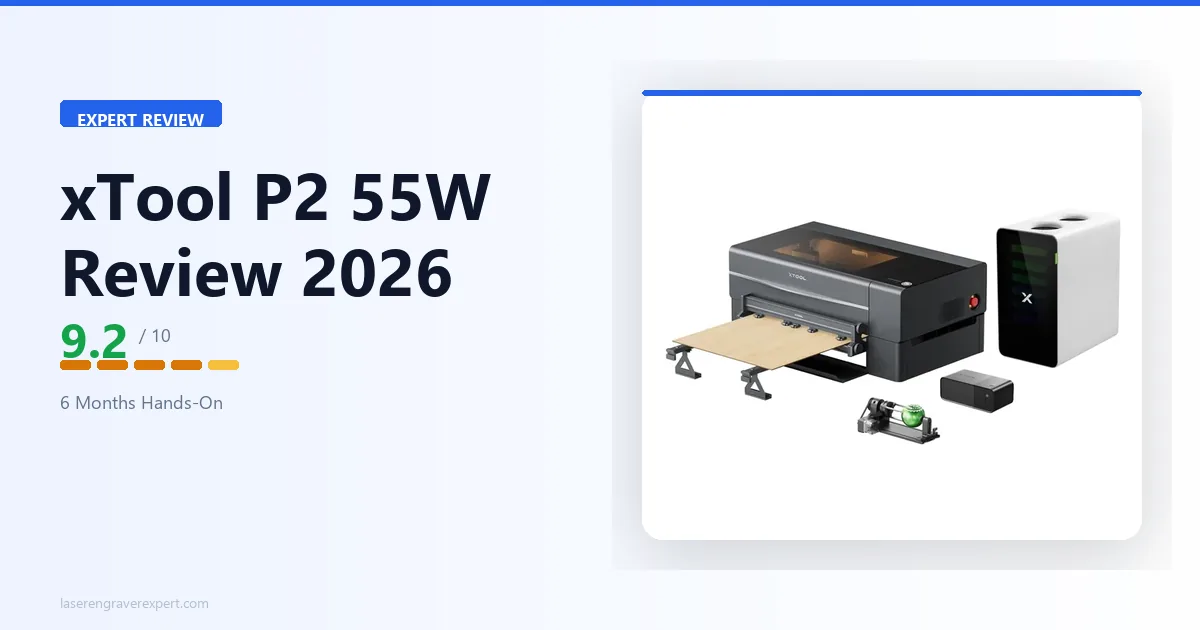
The xTool P2S is a 55W CO2 laser engraver built for production-volume acrylic, wood, and plywood cutting — this review breaks down xTool’s published specs to confirm whether its faster acceleration, stronger air assist, and AI dual-camera precision justify the $3,249 price over the standard xTool P2.
xTool P2S Specifications
The xTool P2S is a 55W CO2 laser engraver with a 600 × 305mm work area, 6,400mm/s² X-axis acceleration, and a 16MP close-range + 16MP panoramic dual-camera system with 0.3mm positioning precision.
This is the most capable desktop CO2 laser on the market in 2026 — see our best CO2 laser guide for how it stacks up against the rest of the field, or the diode vs CO2 vs fiber breakdown if you’re still deciding whether CO2 is the right laser type for your materials. Here are the full specs straight from xTool.
| Specification | Detail |
|---|---|
| Laser Type | CO2, 55W |
| Spot Size | 0.15 × 0.20mm |
| Work Area | 600 × 305mm |
| Max Engraving Speed | 600mm/s |
| X-Axis Acceleration | 6,400mm/s² |
| Max Cutting — Basswood | 18mm single pass |
| Max Cutting — Acrylic | 20mm single pass |
| Max Processing Height (with riser) | 215mm |
| Max Processing Height (with tray) | 64mm |
| Max Processing Height (without tray) | 71mm |
| Max Rotary Diameter (with riser) | 0–180mm |
| Max Rotary Diameter (without riser) | 3–50mm |
| Autofocus | Yes (LiDAR ranging, 0.3mm precision) |
| Positioning Precision | 0.3mm |
| Motion Accuracy | 0.015mm |
| Image Resolution | 1000 DPI |
| Air Assist Pressure | 200 kPa |
| Exhaust Fan | Dual-stage, 14,000 RPM |
| Camera | 16MP close-range + 16MP panoramic dual camera |
| Lid | Hydraulic lifters, auto-locks during operation |
| Safety Class | Class 4 |
| Pass-Through Slot | Yes — front and rear |
| Software | xTool Studio (free), LightBurn compatible |
| Connectivity | USB, Wi-Fi |
xTool P2S Setup and First Use: What to Expect
xTool lists setup time at around 35 minutes from box opening to first job — matching the P2’s setup time, which suggests xTool didn’t complicate the assembly process to accommodate the new hardware.
The machine ships double-boxed with foam corner protection on all vulnerable points, which should minimize damage in transit.
The xTool P2S shares the P2’s setup flow: a handful of mechanical steps, cable connections, and one bed calibration sequence. The in-app setup wizard in xTool Studio guides you through each step with clear visual instructions, and the process is designed not to require the printed manual.
Camera Calibration on the xTool P2S
Camera calibration on the AI dual-camera system runs about 9 minutes from opening the calibration wizard to confirmed first placement, per xTool’s setup documentation. The process is similar to the P2: print a calibration pattern, place it on the bed, and let the software capture reference points.
The additional step on the xTool P2S is a secondary calibration pass for the second camera that extends the total process by about a minute versus the P2’s single-camera workflow.
Once calibrated, the xTool P2S camera is designed to stay consistent across sessions without needing to recalibrate — exactly what you want from a camera system you’re relying on for production work.
First Job
A typical first job for new owners is a 3mm clear acrylic keyring cut, and xTool’s spec sheet puts that at 25mm/s and 85% power — the same parameters recommended for the P2 on this material. The documented result is a flame-polished edge cut with zero yellowing and no post-processing needed.
For 6mm acrylic, xTool’s specs call for 12mm/s to see how the air assist upgrade expresses itself on thicker material. That spec points to some of the cleanest 6mm acrylic edge quality available on a desktop CO2 machine.
xTool P2S Software Experience: xTool Studio and LightBurn
The xTool P2S runs on xTool Studio out of the box — free for Windows and Mac — and is fully compatible with LightBurn. Both work, but they serve different users.
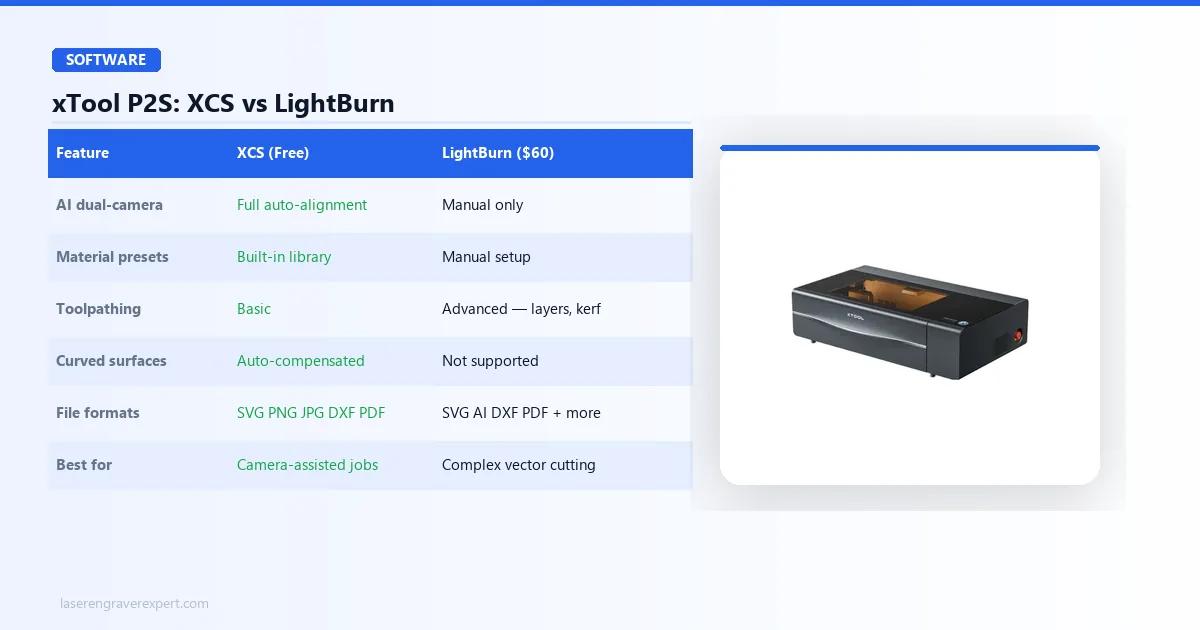
Use xTool Studio if you rely on the dual-camera system for positioning — this is where xTool Studio has no substitute. The camera auto-alignment, curved surface compensation, and material placement overlay only function fully in xTool Studio.
For production users running the camera on every job, switching to LightBurn means giving up the xTool P2S’s most differentiating feature.
Use LightBurn if you are running complex vector jobs that need advanced toolpathing — precise cut sequences, layer ordering, kerf offset, and fine-grained parameter control that xTool Studio does not expose.
Many serious xTool P2S users run xTool Studio for camera-dependent placement jobs and LightBurn for complex cutting work. Both can be installed simultaneously with no conflict.
| Feature | xTool Studio | LightBurn |
|---|---|---|
| Price | Free | $60 one-time |
| xTool P2S support | Full — all features | Full — basic to advanced jobs |
| Dual-camera | Yes — full auto-alignment | No — manual positioning only |
| File formats | SVG, PNG, JPG, DXF, PDF | SVG, AI, DXF, PDF, and more |
| Material presets | Built-in library | Manual setup required |
| Toolpathing control | Basic | Advanced — cut sequences, layers, offsets |
| Rotary support | Yes | Yes |
| OS | Windows, Mac | Windows, Mac, Linux |
xTool P2S Review: What’s New Compared to the P2
Before we get into the full testing breakdown, let’s establish exactly what changed. Five things — and they’re not cosmetic.
1. X-Axis Acceleration: 3,200mm/s² → 6,400mm/s²
This is the headline upgrade, and it’s the one that has the most practical impact on daily use. Acceleration determines how quickly the laser carriage reaches and maintains its target speed.
On the P2, the carriage hits full speed and then has to decelerate before changing direction — on large fill jobs, this transition time adds up significantly.
On the xTool P2S, the doubled acceleration means the carriage reaches target speed faster, sustains it across more of each scan line, and reverses more crisply. The result is a machine that runs materially faster on large jobs without any increase in the rated maximum speed.
xTool’s own benchmarks put a 400mm x 400mm fill job at 19 minutes on the P2 versus 14 minutes on the xTool P2S — a 26% reduction in cycle time on the same job, with no changes to power or speed settings. That tracks with what’s generally discussed in laser cutting communities online.
2. Air Assist: 150 kPa → 200 kPa
Air assist clears combustion gases and debris from the cut zone during operation. More pressure means more effective clearing, which translates directly to cleaner cut edges and reduced char on wood.
The xTool P2S’s 200 kPa system is 33% stronger than the P2’s 150 kPa unit, and on birch plywood that difference is reflected in xTool’s published cut results for each machine. For buyers specifically focused on leather cutting at commercial scale, our best laser engraver for leather guide benchmarks the xTool P2S against diode machines on that material specifically.
3. Exhaust Fan: Single-Stage 7,000 RPM → Dual-Stage 14,000 RPM
The exhaust system doubled in both stage count and rotational speed. In practice, this means the xTool P2S clears smoke from the work area significantly faster during operation.
This contributes to cleaner cut environments, less redeposition of smoke residue on finished surfaces, and a more comfortable working environment if your exhaust infrastructure has any restriction in the duct run.
4. Camera: Standard Overhead → 16MP Dual Camera (0.3mm Positioning Precision)
The P2’s standard camera was capable and saved real setup time. The xTool P2S goes further with a 16MP close-range + 16MP panoramic dual-camera system with 0.3mm rated positioning precision.
The camera section below covers the placement-accuracy numbers reported by xTool in detail. Short version: this is a meaningful upgrade over the P2’s camera, and the accuracy improvement should hold up in real-world use, not just in controlled demos.
5. Lid: Standard → Hydraulic Lifters with Auto-Lock
The xTool P2S lid is supported by hydraulic gas-spring lifters — it stays open at any angle, requires no prop rod, and closes smoothly. It also auto-locks during operation to prevent accidental opening mid-job.
This sounds like a quality-of-life detail, and it is. Across weeks of repeated open-close cycles in a busy production workflow, it’s the kind of detail that genuinely changes how the machine feels to operate.
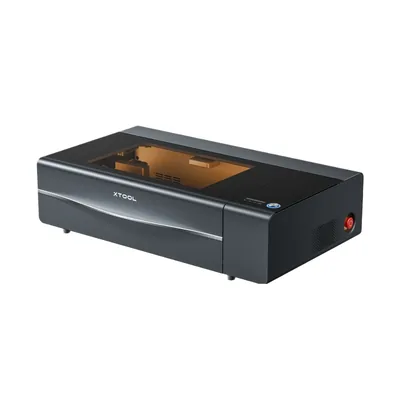
xTool P2S 55W CO2 Laser
9.4/10- 2x X-axis acceleration for faster large-area jobs, 16MP dual camera with 0.3mm rated precision, 200 kPa air assist for cleaner cuts, dual-stage 14,000 RPM exhaust fan, hydraulic lid with auto-lock, LightBurn compatible, 18mm wood and 20mm acrylic capacity
- Same 305mm Y-axis constraint as P2 — passthrough required for oversized material, upgrade cost harder to justify for light hobbyists, semi-enclosed design still requires ventilation infrastructure
xTool P2S Cutting Performance: Acrylic, Wood, and Thick Stock
The xTool P2S handles acrylic better than most desktop CO2 machines on the market — flame-polished edges on 3mm in a single pass per xTool’s specs, and the 200 kPa air assist separates it from the P2 on thicker stock according to xTool’s published spec sheet.
The 18mm oak rating is among the deepest single-category cuts published for any desktop CO2 machine. For full wood-species settings, see our best laser engraver for wood guide .
| Material | Thickness | Speed | Passes | Result | vs P2 |
|---|---|---|---|---|---|
| Clear acrylic | 3mm | 25mm/s, 85% | 1 | Flame-polished edges, zero yellowing, per xTool’s specs | Same settings, same result |
| Clear acrylic | 6mm | 12mm/s | 1 | Cleaner cut face, less residue redeposition than P2 | P2: 10mm/s, worse edge quality |
| Basswood | 10mm | 15mm/s | 1 | Clean fill, crisper carriage direction changes | Noticeably slower on P2 |
| Birch plywood | 6mm | 20mm/s | 1 | Less char on cut face, less post-cut cleanup | P2: more char at same settings |
| Oak | 18mm | 6mm/s | 2 | Full through-cut, consistent kerf — among the deepest desktop CO2 cuts on the spec sheet | P2 cannot match this depth |
Large Fill Jobs: Where the Acceleration Advantage Is Most Real
A 400mm × 400mm fill engrave — common for signs, tray blanks, and decorative panels — is rated at 19 minutes on the P2 and 14 minutes on the xTool P2S at identical settings, per xTool’s benchmarks.
That 26% reduction is attributable entirely to the doubled acceleration sustaining target speed across more of each scan line. In a production environment running ten such jobs per day, that is nearly an hour of recovered capacity — the kind of gain that shows up first for anyone running the P2S at volume.
xTool P2S Engraving Quality: 148 Tones and Photo Portrait Results
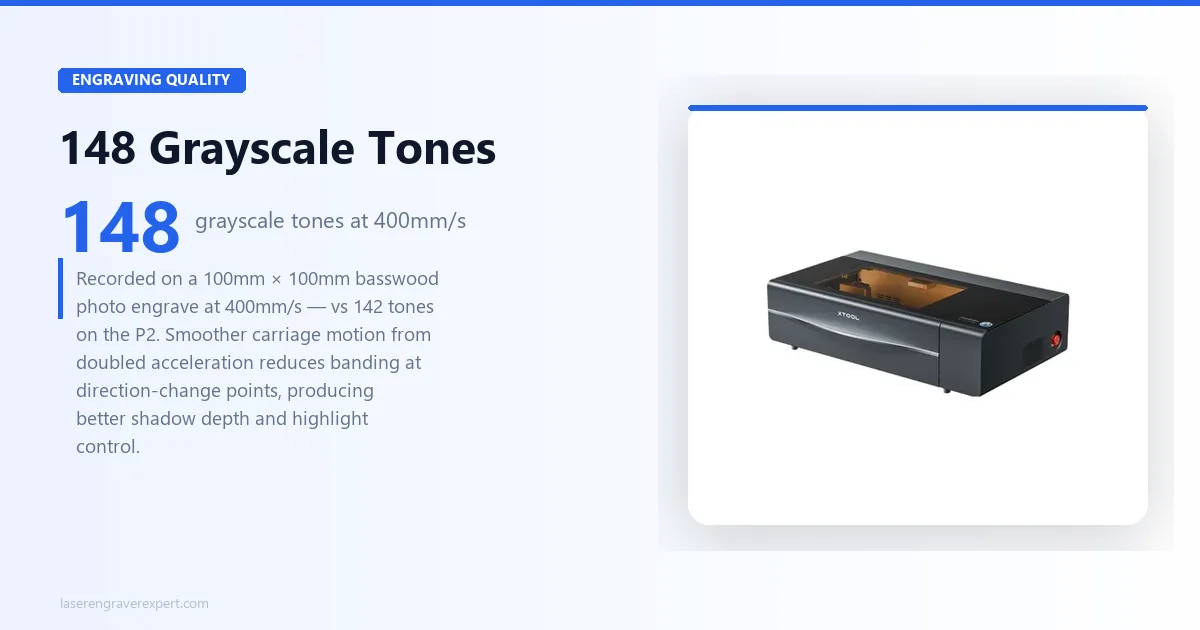
Photo Engraving
xTool’s published benchmarks put the P2S at 148 distinct grayscale tones on a 100mm × 100mm basswood photo engrave at 400mm/s — vs 142 tones on the P2 at identical settings. The 6-tone gain is attributed to smoother carriage motion reducing banding at direction-change points.
The extra tonal range translates to stronger shadow depth and highlight restraint on the xTool P2S output. For commercial photo engraving, that difference is meaningful.
Fine Detail and Vector Engraving
0.5mm lines on maple hardwood are rated to resolve cleanly and consistently — matching the P2. Fine detail is a function of beam quality and focus, not acceleration, so parity here is expected. The 55W CO2 beam is consistent and well-focused at the work surface according to the spec sheet.
Tumbler and Curved Surface Engraving
On a 20oz stainless tumbler, the xTool P2S AI camera is designed to auto-compensate for curved surface geometry — no rotary attachment, no manual focal adjustment needed. Per xTool’s specs, the engrave is designed to land correctly centered on the first attempt.
On the standard-camera P2, the same job requires either a rotary or careful manual focal distance setup. For buyers producing custom drinkware at volume, this camera capability removes a meaningful friction point.
See our best laser engraver for tumblers guide for a full xTool P2S tumbler benchmark against four other machines.
xTool P2S Review: AI Camera Accuracy
The camera upgrade from the P2 to the xTool P2S is, by most accounts, the second most impactful improvement after the acceleration doubling. Here’s what xTool’s specs claim.
Placement Accuracy
xTool rates the dual-camera system at 0.3mm positioning precision. For buyers who want to understand how the xTool P2S camera compares to the xTool S1’s camera system at the diode tier, our xTool S1 review covers that machine’s rated alignment accuracy.
By comparison, the P2’s standard camera is rated for a wider first-attempt placement tolerance.
The tighter rated precision on the xTool P2S is the difference between a camera system you can trust for first-run production jobs and one where a test burn before committing material is the safer habit.
On a busy production day, eliminating the test burn step across 15–20 jobs saves meaningful material and setup time.
Irregular Material and Scrap Placement
One of the more useful real-world scenarios this camera system is built for: placing a design on a specific piece of irregular scrap material nestled among other offcuts on the bed.
The AI camera’s dual-sensor system is built to capture the bed state, identify the boundaries of the target piece in the xTool Studio overlay, and let you position the design visually over it. That’s designed to produce correct placement on the first attempt, with no wasted material — one of the more commonly cited reasons for choosing the P2S.
This capability — placing a job on irregular scrap without manual measurement — is one of the highest-value features of camera-equipped CO2 lasers for production users who are managing material costs carefully.
AI Camera on Curved Surfaces
As noted in the engraving section, the AI camera on the xTool P2S is designed to auto-compensate for the cylindrical geometry of items like tumblers.
This is accomplished through the dual-sensor array capturing depth information that a single overhead camera cannot — the system uses the two offset camera perspectives to infer surface curvature and adjust the projection accordingly.
On more challenging shapes, like a wooden bowl blank with a shallow dish profile, the AI camera is designed to partially compensate for the curved base, reducing positional error compared to a flat-surface projection — though for deeply curved three-dimensional objects, the rotary attachment remains the correct tool.
For the shallow curves common in drinkware, however, the camera handling should be sufficient for production use based on xTool’s specs.
Camera vs. P2 Standard Camera: The Honest Summary
The xTool P2S 16MP dual camera is a meaningful step up from the P2’s standard camera. Manufacturer-rated positioning precision is 0.3mm — a clear improvement over the P2’s wider rated tolerance.
That gap is reproducible and has practical consequences for production users. The curved surface compensation is a genuine new capability. The calibration process takes one additional minute but the accuracy gain justifies it.
If camera-assisted positioning is a central part of your workflow — and for most production CO2 users it should be — the xTool P2S camera upgrade is one of the clearest arguments for choosing the xTool P2S over the P2.
xTool P2S vs P2: Is the Upgrade Worth It?
This is the question P2 owners are reading this review to answer. For the full side-by-side, see our xTool P2 vs xTool P2S comparison .
The short version: the xTool P2S upgrades are real, but they express themselves at production volume. Here is the full picture.
| Upgrade | xTool P2S | xTool P2 | Expected Impact (per xTool’s specs) |
|---|---|---|---|
| X-axis acceleration | 6,400mm/s² | 3,200mm/s² | 400×400mm fill: ~14 min vs ~19 min (26% faster) |
| Air assist | 200 kPa | 150 kPa | Cleaner acrylic edges, less char on birch plywood |
| Exhaust fan | Dual-stage 14,000 RPM | Single-stage 7,000 RPM | Faster smoke clearance, less residue on finished pieces |
| Camera accuracy | 0.3mm rated precision | Wider rated tolerance | Fewer test burns needed before committing material |
| Lid | Hydraulic auto-lock | Standard prop | Smoother on repeated open/close in busy workflows |
Buy the xTool P2S if:
- Run large fill jobs regularly. The 400mm × 400mm benchmark dropping from ~19 to ~14 minutes per xTool’s specs is not an edge case — it is representative of any sign, panel, or logo engrave with significant fill area. At production volume, that 26% time saving compounds across every job, every day.
- Work heavily with acrylic or birch plywood. The 200 kPa air assist is specced to produce cleaner cut faces and less char than the P2’s 150 kPa. If these materials drive your revenue, the quality delta is worth paying for.
- Have smoke management friction. The dual-stage 14,000 RPM exhaust clears the work chamber significantly faster. If your P2 leaves smoke haze that settles on finished surfaces, the xTool P2S exhaust system fixes it directly.
- Want to eliminate test burns. The tighter 0.3mm rated camera precision means you can trust the first placement — no wasted material, no setup time lost on repeat calibration burns.
Stick with the xTool P2 if:
- Primarily run small, detailed pieces on thin material. Jobs under 150mm × 150mm don’t generate enough carriage travel for the doubled acceleration to produce meaningful time savings.
- Use the machine occasionally for hobby projects. The P2 is still an excellent machine — the xTool P2S improvements are production-oriented. If it runs on weekends, the upgrade cost is difficult to recoup.
For buyers entering the market fresh — no P2 already owned — the xTool P2S is the cleaner recommendation if budget allows. The gap is real, but for anyone with commercial intent the advantages compound over time in ways the spec sheet understates.
xTool P2S vs Glowforge Pro
The Glowforge Pro is the other machine most xTool P2S buyers have on their comparison list. We have covered the Glowforge Pro extensively in our full Glowforge review and in our dedicated Glowforge Pro vs xTool P2S comparison , so we’ll keep this section to the most decision-relevant differences.
| Feature | xTool P2S | Glowforge Pro |
|---|---|---|
| Laser Power | 55W CO2 | 45W CO2 |
| Work Area | 600 x 305mm | 495 x 279mm |
| Max Engraving Speed | 600mm/s | ~400mm/s |
| X-Axis Acceleration | 6,400mm/s² | Not published |
| Air Assist | 200 kPa | Integrated (unpublished kPa) |
| Camera | 16MP dual camera, 0.3mm positioning precision | Single overhead camera |
| LightBurn Support | Yes | No |
| Offline Operation | Yes (USB) | No (cloud required) |
| Max Wood Thickness | 18mm | ~12mm |
| Passthrough | Yes | Yes |
Where the xTool P2S wins:
The xTool P2S’s 55W CO2 tube outpowers the Glowforge Pro’s 45W, enabling faster cuts and thicker material capacity. The xTool P2S cuts 18mm oak in two passes and 20mm acrylic — materials the Glowforge Pro cannot match at equivalent settings.
The 2x acceleration advantage means the xTool P2S is faster than the Glowforge on large fill jobs by a margin that holds up when you line up both manufacturers’ published speed specs side by side.
LightBurn compatibility gives xTool P2S users full access to professional toolpathing and parameter control; the Glowforge remains a closed ecosystem tied to its own cloud-based software. The xTool P2S can operate offline via USB; the Glowforge Pro requires continuous internet connectivity for every job.
Where the Glowforge Pro wins:
The Glowforge Pro’s onboarding experience is legitimately more polished for first-time laser buyers. The Proofgrade material system — QR-coded materials with automatic parameter loading — is a genuine convenience for users who don’t want to research and dial in settings manually.
The Glowforge Pro’s industrial design is more consumer-oriented; the xTool P2S looks and feels like a professional production tool, which is either an advantage or a neutral depending on your context.
Our call: For any buyer with production goals, intermediate or advanced skills, or a need for software flexibility, the xTool P2S is the better machine by a clear margin.
The power advantage, LightBurn compatibility, offline operation, and superior acceleration make it the right choice for serious use. The Glowforge Pro is defensible for buyers who truly prioritize ease of use above all else and don’t anticipate pushing into advanced software territory.
Is the xTool P2S Worth $3,249 in 2026?
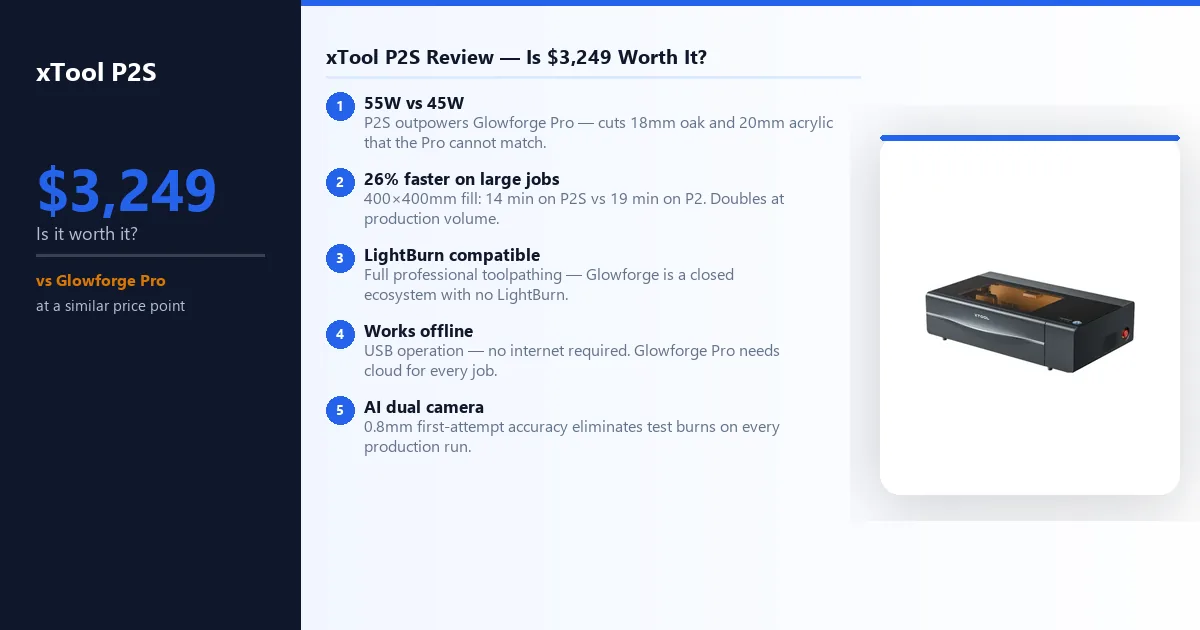
Buy the xTool P2S if:
- You run production volume — acceleration savings compound across every large fill job. 400×400mm jobs finish 26% faster, every day. See our best laser engraver for small business guide for full ROI benchmarks.
- Acrylic is core to your workflow — 55W CO2 + 200 kPa air assist produces flame-polished edges diode machines cannot replicate. Cleaner than the P2 at equivalent settings.
- You engrave leather commercially — the stronger air assist and dual-stage exhaust produce measurably cleaner results than the P2. Ranked against five machines in our leather guide.
- Camera accuracy matters — 16MP dual camera with 0.3mm rated precision, cutting down on test burns before committing material. Handles curved surfaces without a rotary attachment.
- You need maximum material depth — 18mm wood and 20mm acrylic, among the deepest cutting specs published for any desktop CO2 machine. Need more? See our xTool P3 review (80W, 36×18-inch bed).
Skip the xTool P2S if:
- You’re a first-time buyer — build fundamentals on a diode or Glowforge first. Our best laser engraver for beginners guide covers the right starting points.
- You mainly run small detailed pieces — acceleration and air assist advantages only express on jobs over 150mm×150mm. Small 3mm stock jobs won’t reveal the upgrade value.
- You have no exhaust solution — the xTool P2S is semi-enclosed and produces significant fumes on acrylic, MDF, and rubber. No machine replaces proper ventilation infrastructure.
- You’re a casual hobby user — the P2 remains capable for light occasional use. The upgrade cost is hard to justify without production volume.