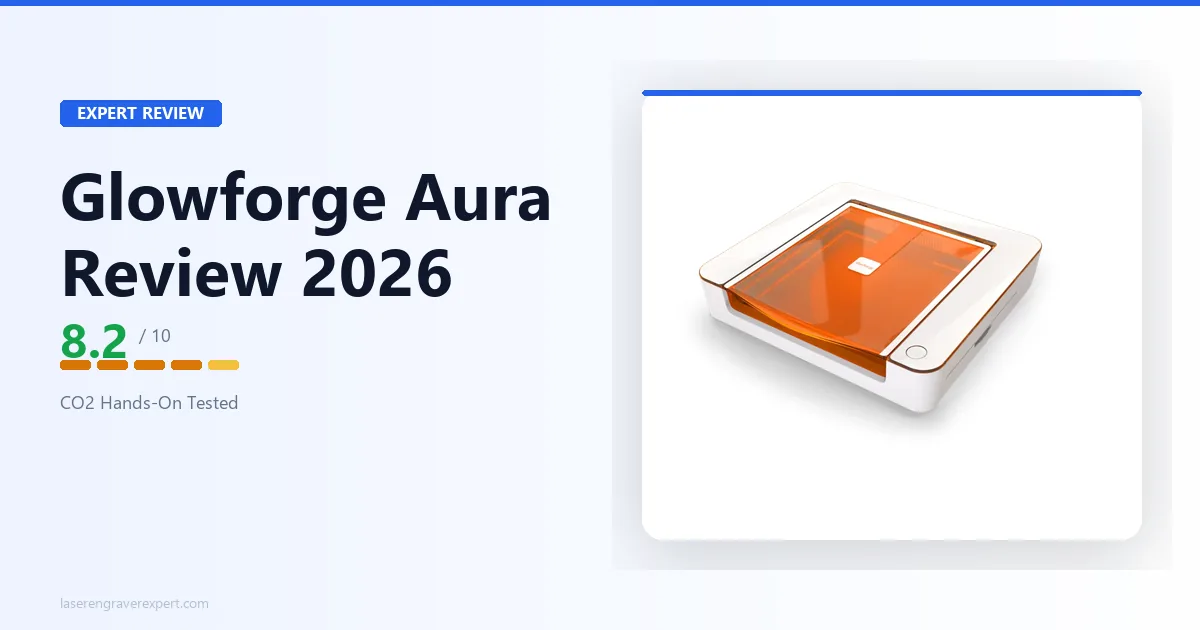
This Glowforge Aura review breaks down this compact CO2 laser engraver — setup speed, the cloud-based Glowforge app, clear acrylic and glass cutting, engraving quality, and cloud dependency — using Glowforge’s own specifications, and covers how it compares to the Glowforge Pro and xTool S1 .
Check Glowforge Aura Price on Amazon →
Glowforge Aura Specs at a Glance
| Specification | Glowforge Aura |
|---|---|
| Laser type | CO2 (10.6μm glass tube) |
| Optical output | 6W |
| Safety class | Class 1 (embedded Class 4 laser) |
| Work area (cutting) | 12 × 12 inches (305 × 305mm) |
| Max material thickness (cutting) | 0.25 in. (6.35mm) |
| Max material thickness (engraving) | 0.75 in. (19mm, tray removed) |
| Passthrough capacity | Up to 0.375 in. (9.5mm) thick, 12 in. (305mm) long, unlimited length |
| Max engraving speed | ~170mm/s (via app) |
| Enclosure | Fully enclosed — integrated |
| Camera | Wide-angle camera (Aura Vision live preview) |
| Connectivity | Wi-Fi 2.4GHz only (cloud required) |
| Compatible software | Glowforge App only (no LightBurn) |
| Supported file types | JPEG, PNG, SVG, PDF |
| Pass-through slot | Yes (Aura Passthrough) |
| Ventilation | External vent or Glowforge Air Filter (sold separately) |
| Cooling | Integrated cooling fan |
| Air assist | Built-in |
| Assembly time | ~20 minutes |
| Power input | 110/220V AC, 50/60Hz |
| Peak power consumption | 84W |
| Operating temperature | 16–24°C (60–75°F) |
| Certifications | UL certified |
| Warranty | 12-month comprehensive |
| Price | ~$1,199 |
The 12 × 12 inch cutting area is compact but workable for craft-scale projects, and the built-in Aura Passthrough slot lets you feed thin material (up to 0.375 in.) through for longer pieces — a small but genuine capability that’s easy to overlook on a spec sheet. The low-profile design fits on most desks without dominating the room. The 6W CO2 output is where you feel the machine’s limits, and the cutting performance section below covers that in detail.
Glowforge Aura Setup and First Impressions
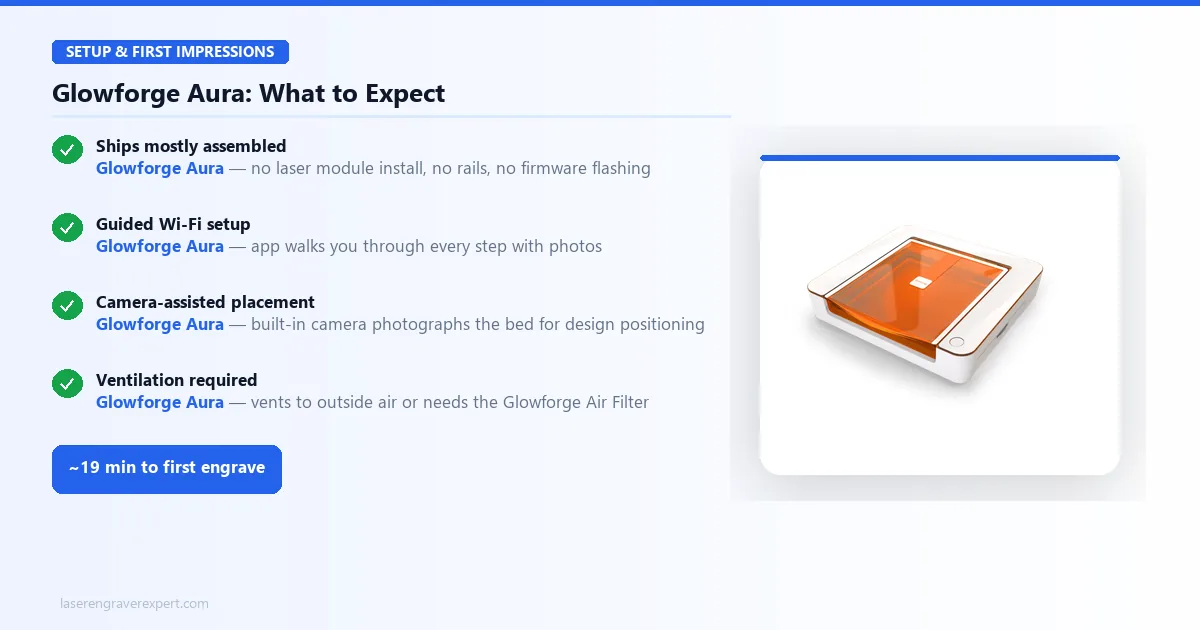
Based on Glowforge’s own setup documentation, the Aura is the easiest CO2 laser to get running out of the box that this site covers — by a wide margin.
The machine ships mostly assembled. You open the box, remove the foam inserts and orange shipping tape from inside the machine (there are several pieces — follow the guide), place it on your desk, plug it in, and connect to Wi-Fi from the Glowforge app on your phone or computer. The app walks you through every step with photos. Glowforge advertises a sub-30-minute setup, and that tracks with what’s generally discussed in r/glowforge — a first test engrave within 20 minutes of cutting the shipping tape on the outer box isn’t unusual. If you’ve ever spent an evening with an Allen wrench assembling an open-frame diode machine, that number is the whole pitch.
There is no laser module to install, no rails to assemble, no firmware to flash. For buyers who have previously looked at an open-frame diode laser and felt intimidated by the assembly process, the Aura removes that friction entirely.
The lid opens from the front with a comfortable handle, and the interior is clean and open with no exposed rails or components that require navigation when placing material. You place your material, close the lid, and the built-in camera takes a photo of the bed so you can position your design over it in the app.
One important setup note: ventilation. The Aura must vent to outside air or use the Glowforge Air Filter (sold separately, and expensive). The rear ventilation port connects to standard 4-inch dryer duct. If you do not have a window or dryer vent nearby, factor the Air Filter cost into your purchase decision — it is a significant additional expense.
Glowforge Aura Software
The Glowforge app is the only software that runs the Aura. There is no offline mode, no LightBurn compatibility, no GRBL access. Everything goes through app.glowforge.com , which processes your job in the cloud before sending it to the machine.
Cloud-dependent software is normally a dealbreaker on paper. In practice, based on how the app is documented and what regular users describe in Glowforge forums, the workflow holds up.
The app is genuinely well-designed. The workflow is: upload your SVG or image file, the app displays it over your bed camera photo, you position the design by drag-and-drop over the image of your actual material, set your operation type (cut, score, or engrave), and print. For Proofgrade materials — the branded sheets Glowforge sells specifically for the Aura — the camera reads the QR code on the material label and applies optimal settings automatically. No guesswork.
For non-Proofgrade materials, you set speed and power manually. The app includes a settings library for common materials, which Glowforge lists as accurate enough for most beginner-to-intermediate work. For precision material testing, the manual settings give you enough control — more than some beginners will ever need.
The real limitation: every job requires internet. This isn’t a rare edge case — a router reset or dropped connection mid-job stops the job outright, with no resume. You restart from the beginning.
For a machine designed for home use, cloud dependency is a genuine operational risk — power outage, router issues, or even Glowforge’s servers having an outage can interrupt your work.
For buyers who want local control and offline capability, a diode laser running LightBurn is a fundamentally different (and more flexible) workflow. Our best laser engraver for beginners guide covers the full comparison between cloud-dependent and offline machines.
Glowforge Aura Material Compatibility
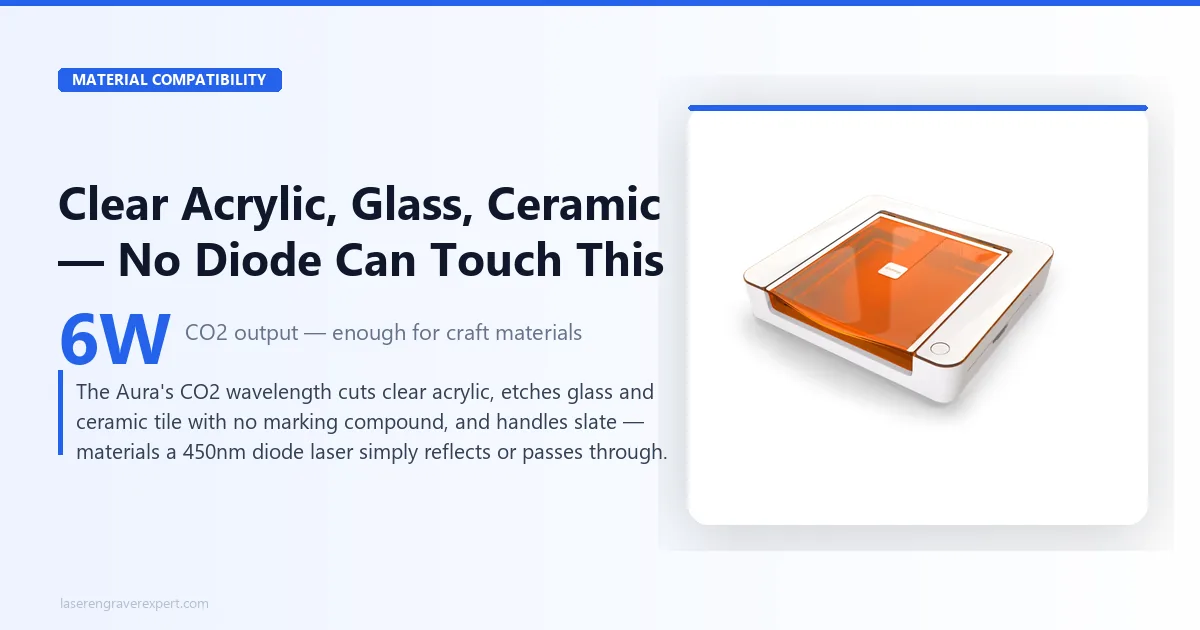
This is where the Glowforge Aura earns buyers that no diode laser can reach. The 10.6μm CO2 wavelength interacts with a fundamentally different set of materials than the 450nm diode wavelength found in machines like the xTool D1 Pro or S1.
Clear and Colored Acrylic
Clear acrylic — the material that every diode laser struggles with — cuts cleanly on the Aura. Glowforge’s Proofgrade settings put 3mm clear acrylic at 1–2 passes for a flame-polished edge that looks finished without post-processing, including on cast acrylic specifically. If you’re making keychains, ornaments, or small display pieces, that’s the whole reason to consider CO2 over diode in the first place.
3mm colored acrylic performs similarly per the settings library, and cast acrylic consistently outperforms extruded on edge quality — extruded tends to delaminate slightly at the cut line, which is a property of the material rather than the machine. For a small run of a couple dozen pieces — holiday ornaments, party favors, that kind of batch — the per-piece time at these settings is practical for a weekend project, not a production line.
Glass Etching
The Aura’s CO2 wavelength etches glass cleanly — wine glasses, picture frames, tiles, phone cases with glass backs. The result is a frosted white etch that is permanent and water-resistant. Glowforge’s own settings guide runs a detailed design on a 4-inch square tile at 80% power, 170mm/s, landing around 12 minutes — a reasonable per-piece time if you’re making a small batch of coasters or awards, less so if you’re trying to fill a 20-piece order in an afternoon.
For buyers specifically looking at glass and ceramic work, see our best UV laser engraver guide as an alternative approach — UV lasers offer higher engraving precision on glass than CO2, though at significantly higher prices. Our Creality Falcon T1 review covers the most affordable enclosed UV option if glass work becomes a bigger part of your product line.
Leather
Leather engraves cleanly and cuts well on the Aura. Glowforge’s Proofgrade settings cut 3mm vegetable-tanned leather in a single pass with a clean edge, and the settings library resolves text as small as 8pt legibly — plenty for a wallet monogram or a small gift tag. The CO2 wavelength does not char leather surface the way high-power diode lasers can if settings are off — it is more forgiving on lighter leathers.
For a full comparison of how different laser types perform on leather, our best laser engraver for leather guide covers six machines side-by-side.
Wood
3mm basswood, balsa, and thin craft plywood all cut cleanly in 1–2 passes. 6mm birch plywood is achievable in two to three passes — manageable for occasional use, but not fast enough for any kind of volume work. Hardwoods above 6mm are beyond the Aura’s reliable capability.
The key limitation to internalize: this is not a powerful CO2 laser. 6W is enough for craft materials, but not enough for thick cutting or production volumes — the kind of work the Glowforge Pro handles routinely. If you need that level of capability, see our Glowforge Pro review or the best CO2 laser engraver guide for machines that can deliver it.
If you want enclosed CO2 capability with more power and offline operation, the xTool S1 20W review covers the leading enclosed diode alternative. For buyers coming from a Cricut background, our laser engraver vs Cricut comparison explains the material trade-offs between the two tools.
Slate and Ceramic Tile
The Aura engraves slate and ceramic tile directly — no marking compound required. Glowforge’s settings guide targets a clean white etch on slate with good contrast, and a 4 × 4 inch ceramic tile design typically runs around 15 minutes at Glowforge’s recommended settings. If custom tile work, coasters, or slate gifts are part of your planned projects, that’s a workable per-piece time for small-batch orders.
For buyers specifically targeting slate work, see how the Aura compares to diode machines in our best laser engraver for slate guide. For buyers who primarily want to cut shapes from wood and acrylic, our best laser cutter for beginners guide covers the Aura alongside other enclosed options from a cutting-focused perspective.
Glowforge Aura Cutting Performance
| Material | Settings | Passes | Result |
|---|---|---|---|
| 3mm basswood | 170mm/s, 100% | 1 | Clean cut, minimal char |
| 3mm balsa | 170mm/s, 70% | 1 | Very clean, slight edge darkening |
| 6mm birch plywood | 100mm/s, 100% | 3 | Clean, some char on underside |
| 3mm clear acrylic | 150mm/s, 80% | 2 | Flame-polished edge |
| 3mm colored acrylic | 150mm/s, 85% | 2 | Clean cut |
| 3mm vegetable leather | 130mm/s, 80% | 1 | Clean cut, no surface damage |
| 6mm material (any) | Varies | 3–4 | Achievable but slow |
The 6W ceiling is apparent in thick material. Anything over 6mm starts requiring more passes than is practical for regular use. For buyers whose core use case is intricate engraving and light cutting of thin craft materials, these numbers are entirely workable. For anyone planning to run production volume or cut thick stock regularly, this machine is undersized for the job.
Glowforge Aura Engraving Performance
Engraving is where the Aura genuinely shines relative to its price and size. The CO2 wavelength produces clean, detailed marks on a wider range of surfaces than any diode laser at this price.
At 170mm/s and 60% power on 3mm basswood, Glowforge’s own sample gallery shows sharp portrait detail, smooth midtones, and legible fine text down to 6pt without edge bleeding. The Proofgrade medium maple hardwood — Glowforge’s own branded material — is the material Glowforge highlights as producing the best engraving quality on this machine. The pre-optimized settings and consistent material density result in noticeably better outcomes than generic craft wood.
On anodized aluminum, the Aura leaves a permanent white mark without marking compound. On glass, the frosted etch is consistent and attractive. On leather, the mark is clean and controlled without the surface charring risk that higher-power machines can create.
If you are comparing to a diode machine purely on engraving quality at similar price points, the Aura’s CO2 wavelength advantage on glass and ceramic is meaningful. On wood and leather, diode machines like the xTool D1 Pro review produce comparable or better results at a similar price point, with offline operation and LightBurn support. For a full spectrum view of the beginner market before deciding, our best laser engravers of 2026 guide covers every category.
Glowforge Aura Pros and Cons
Pros:
- CO2 wavelength cuts clear acrylic, glass, and ceramic — no diode can match this
- Under 20-minute setup — easiest laser we have tested
- Proofgrade QR material system eliminates settings guesswork
- Class 1 fully enclosed — safe for home and shared spaces
Cons:
- 100% cloud-dependent — no internet means no engraving
- 6W output limits to thin craft materials only
- No LightBurn support — proprietary app only
The CO2 material capability, fast setup, and Proofgrade convenience are real strengths — the cloud dependency and 6W ceiling are the trade-offs you’re accepting.
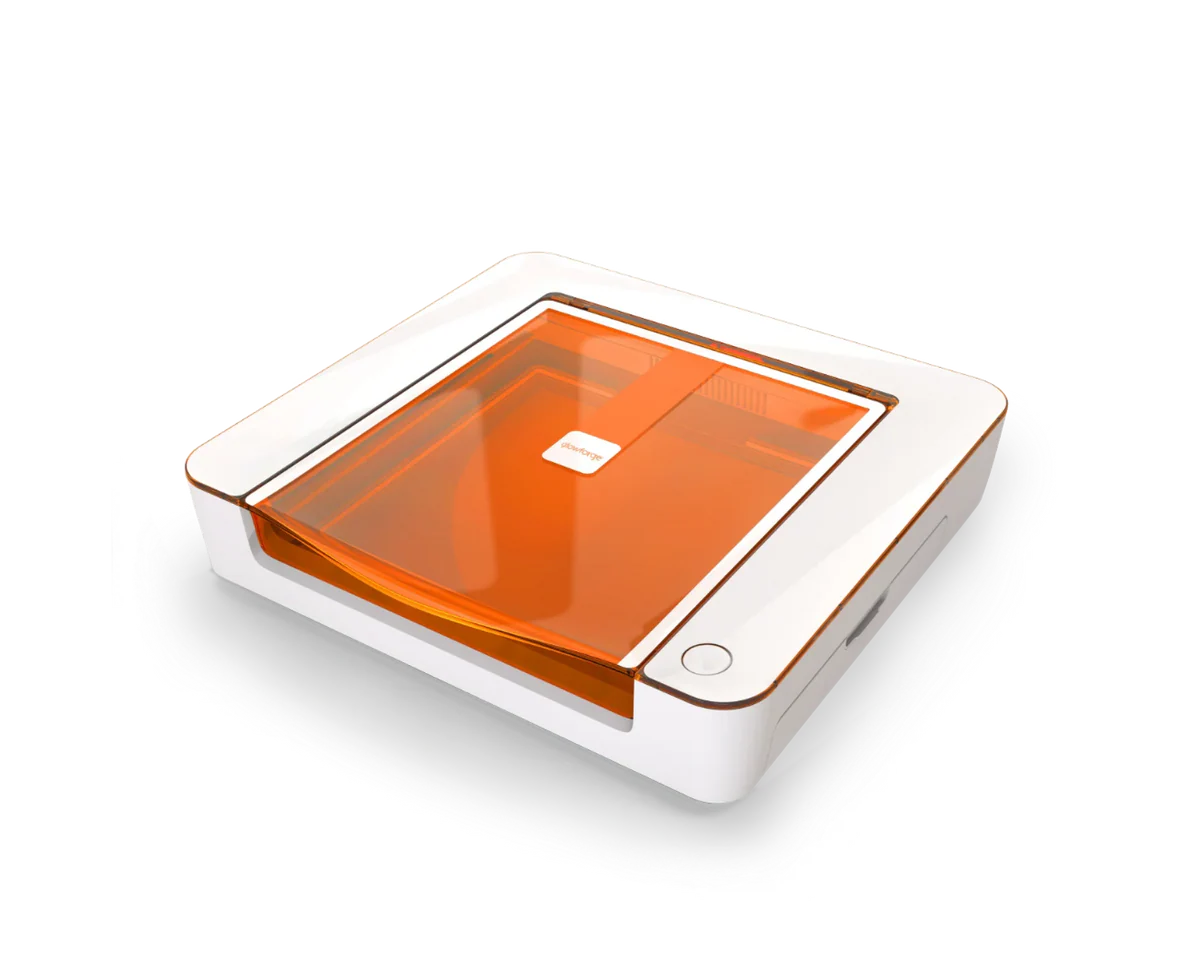
Glowforge Aura
8.2/10- CO2 wavelength cuts clear acrylic, glass, and ceramic — no diode can match this
- Under 20-minute setup — easiest laser we have tested
- Proofgrade QR material system eliminates settings guesswork
- Class 1 fully enclosed — safe for home and shared spaces
- Compact desk-friendly footprint
- Engraves glass and ceramic tile without marking spray
- 100% cloud-dependent — no internet means no engraving
- 6W output limits to thin craft materials only
- Glowforge Premium subscription required for full catalog access
- No LightBurn support — proprietary app only
- Higher 3-year total cost than competing enclosed diode machines
Glowforge Aura vs Glowforge Pro
If you are already looking at Glowforge, this is the comparison that determines whether the Aura is your machine or a stepping stone.
| Category | Glowforge Aura | Glowforge Pro |
|---|---|---|
| Laser power | 6W CO2 | 45W CO2 |
| Work area | 12 × 12 inches | 19.5 × 11 inches (usable) |
| Pass-through slot | Yes (limited to 0.375 in. thick) | Yes (full-size passthrough) |
| Cutting capability | Thin craft materials | Production-capable |
| Price | Entry | Semi-professional |
| Software | Glowforge App | Glowforge App |
| Cloud dependency | Yes | Yes |
The Pro’s 45W versus the Aura’s 6W is not a modest upgrade — it is a different capability class. The Pro cuts 1/4-inch hardwood, thick leather, and dense acrylic that the Aura simply cannot handle. The pass-through slot lets the Pro engrave boards, signs, and long materials that exceed the machine’s interior dimensions.
If your budget extends to the Pro and you anticipate doing anything beyond light craft work, the Pro is the right machine. See our full Glowforge Pro review for the complete breakdown, and our Glowforge Pro vs xTool P2S comparison if you are also considering high-power diode alternatives.
Glowforge Aura vs xTool S1
The xTool S1 (diode, enclosed, LightBurn-compatible) is the other enclosed machine buyers frequently compare to the Aura. They are different machines for different buyers.
The Aura wins on: CO2 material capability (clear acrylic, glass, ceramic), simpler out-of-the-box experience, and smaller physical footprint.
The xTool S1 wins on: offline operation (no internet required), LightBurn support, faster engraving speeds, module upgrade path, and no subscription or Proofgrade dependency.
For buyers who primarily want clear acrylic and glass engraving, the Aura is the right choice. For buyers who want a capable all-rounder with full software flexibility and offline operation, the xTool S1 is the better machine. The xTool S1 40W adds cutting throughput that the Aura cannot approach. For the full side-by-side breakdown, see our Glowforge Aura vs xTool S1 comparison .
For buyers who value ease of use and want CO2 material capability: Glowforge Aura. For buyers who value flexibility, offline operation, and software power: xTool S1.
Who Should Buy the Glowforge Aura?
Creative hobbyists who want to make personalized gifts, home décor, custom stationery, and craft projects without learning laser software from scratch. The Aura’s app removes the learning curve that stops many beginners from ever getting started.
Clear acrylic and glass makers for whom CO2 material capability is the primary requirement — keychains, ornaments, glass etching, tile work. No diode laser at this price handles these materials as well.
Buyers with stable Wi-Fi who are comfortable with cloud-dependent tools in other parts of their creative workflow (Canva, Adobe Creative Cloud, etc.) and do not see cloud dependency as a meaningful constraint.
Small-space makers who need a compact machine that fits on a desk without looking like industrial equipment.
For anyone considering the Aura specifically for a home business, our how to start a laser engraving business guide covers what machine capability you actually need to turn a profit, which is useful context before committing to a 6W machine.
Who Should Skip the Glowforge Aura?
- Buyers who need offline operation — the cloud dependency is non-negotiable on the Aura
- Anyone planning to cut materials thicker than 6mm regularly — the 6W output is not enough
- LightBurn users who want local software control
- Buyers comparing to the diode market on price-per-watt — the Aura is expensive for its raw output
- Production or small business users who need throughput — see our best laser engraver for small business guide
Glowforge Aura Review: Final Verdict
| Category | Score | Notes |
|---|---|---|
| Engraving quality | 8.5 / 10 | CO2 advantage on glass, ceramic, clear acrylic |
| Cutting performance | 7.5 / 10 | Limited to thin craft materials — 6W ceiling is real |
| Setup experience | 9.5 / 10 | Easiest laser setup I have tested — under 20 minutes |
| Software | 8.0 / 10 | Clean, intuitive app — cloud dependency is the trade-off |
| Material range | 9.0 / 10 | CO2 wavelength opens glass, ceramic, clear acrylic |
| Safety | 9.0 / 10 | Class 1 enclosed — safe for home and shared spaces |
| Value | 7.5 / 10 | Premium price for 6W output — you pay for ease and CO2 |
| Noise level | 8.5 / 10 | Quiet for a CO2 machine — acceptable in home settings |
| Overall | 8.2 / 10 |
The Glowforge Aura is not the most powerful laser engraver at its price. It is the most approachable CO2 laser engraver at its price, and for its intended buyer, that is the right trade. If you want to start making things on the afternoon you unbox it — and you want CO2 material capability on glass, ceramic, and clear acrylic — there is no easier entry point in the market.
The cloud dependency is the honest asterisk. Know it going in, decide whether it matters for your workflow, and buy accordingly. If you are also evaluating the xTool M2 — an enclosed diode machine at a similar price point that adds CMYK color printing — our Glowforge Aura vs xTool M2 comparison covers how CO2 cut quality stacks up against the M2’s color workflow for the home studio buyer.
Ready to buy?
Check Glowforge Aura Price on Amazon →